
Top 5 Plumbing Problems That Show Up in Spring in Washington Homes
By Magic Flow Plumbing | Serving Lake Stevens, Bellevue, Kirkland & the Greater Seattle, WA Area 📞 425-666-8363
Washington State homeowners deal with a plumbing reality that’s genuinely different from most of the country. We don’t face the brutal deep-freeze winters of Minnesota or the drought-cracked soil of Arizona. What we get instead is something more subtle: months of relentless moisture, saturated ground, rapidly fluctuating temperatures in late winter and early spring, and a Pacific Northwest ecosystem that grows vigorously and relentlessly — including right into your pipes.
The result is a specific, predictable set of plumbing problems that surface every spring across Lake Stevens, Bellevue, Kirkland, and communities throughout the Greater Seattle, WA area. At Magic Flow Plumbing, we see the same five issues climb steadily from March through May, year after year. Some are dramatic. Some are sneaky. All of them are significantly more manageable — and less expensive — when you know what to look for.
Here are the top five plumbing problems Washington homeowners face in spring, why they happen here specifically, and what to do when they show up at your door.
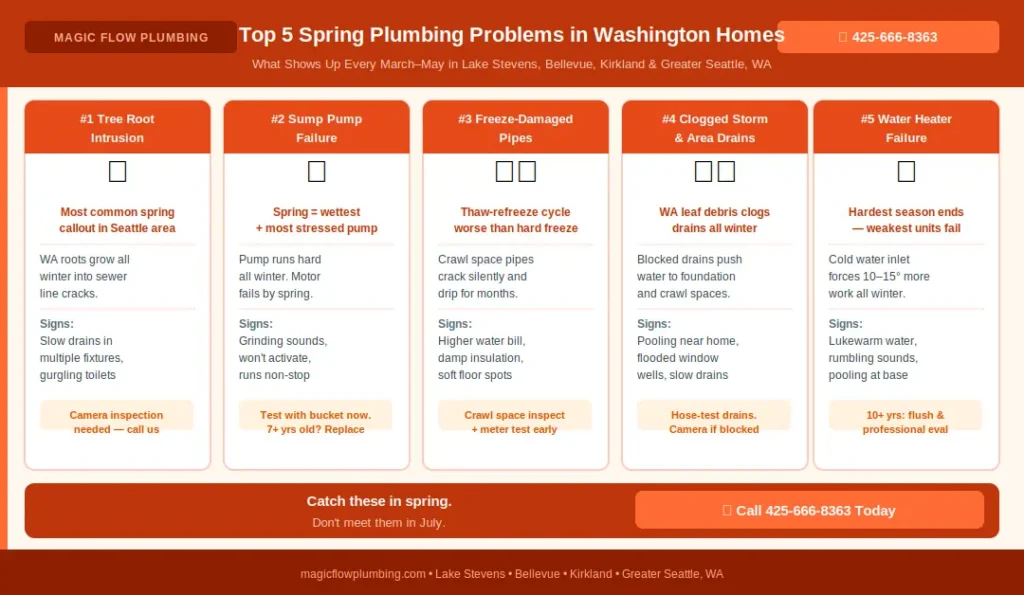
Problem #1: Tree Root Intrusion in Sewer Lines
This is the one that surprises homeowners the most, and it’s the one we’re called out for most consistently in the spring across the greater Seattle area.
Washington’s wet winters create ideal conditions for root growth. The same moisture that keeps the Pacific Northwest green drives tree and shrub root systems to spread aggressively through soil in search of water and nutrients. Your underground sewer line — which carries warm, moisture-rich wastewater — is essentially a beacon for opportunistic roots. Even a hairline crack in an older clay or concrete pipe is enough of an entry point for a root tendril to work its way inside.
Over a wet winter, roots that found a small crack in October have had four to five months to grow. By spring, what started as a hairline intrusion can be a partial or full blockage. You’ll notice it as slow drains throughout the house, gurgling sounds from toilets when other fixtures drain, or in severe cases, sewage backing up into tubs and floor drains.
Homes in older neighborhoods of Lake Stevens, parts of Kirkland, and established areas of Bellevue with mature tree canopies are especially vulnerable, as older pipe materials are far more susceptible to cracking than modern PVC.
What to do: Slow drains throughout the house — not just one fixture — are the key signal. A single slow drain is usually a local clog. System-wide slow drainage points to the main sewer line. Call Magic Flow Plumbing at 425-666-8363 for a sewer line inspection. Camera inspections can confirm root intrusion without any digging, and catching it before a full blockage means clearing the line rather than replacing it.
Problem #2: Sump Pump Failure After a Hard Winter
If your home has a sump pump — and many homes in low-lying areas of Snohomish County, King County, and around Lake Stevens do — spring is both the most important time for it to work and the most likely time it won’t.
Here’s the cycle we see repeatedly: a sump pump runs heavily through the wet fall months, gets a hard workout during winter storms, then sits in near-continuous use. By spring, when rainfall picks up again and snowmelt from higher elevations begins moving through the watershed, a pump that’s been working at capacity for five months is exactly the one most likely to fail. Burned-out motors, stuck float switches, and clogged discharge lines are all common after a demanding winter season.
The Pacific Northwest’s spring rainfall pattern makes this especially dangerous. Unlike regions where spring brings dry relief, the Greater Seattle, WA area routinely sees its second-wettest period of the year in March and April. A sump pump that fails in a King County basement on a wet April night can flood a finished space with thousands of gallons before anyone notices.
What to do: Test your sump pump now, before you need it urgently. Pour a bucket of water into the pit and confirm the pump activates, runs, and drains the pit completely. Listen for grinding or rattling, which signals mechanical wear. Check that the discharge line exits well away from your foundation and isn’t blocked by winter debris. If the pump is more than seven years old or shows any hesitation, the cost of a replacement is trivial compared to the cost of a flooded basement. Call us at 425-666-8363 and we can assess, repair, or replace your sump pump quickly.
Problem #3: Freeze-Damaged Outdoor and Crawl Space Pipes
The Greater Seattle area doesn’t freeze as hard or as long as eastern Washington, but it freezes enough — and the way it freezes is particularly damaging to residential plumbing. We get cold snaps that drop overnight temperatures to the mid-20s, followed by above-freezing days, followed by another freeze. That thaw-refreeze cycle is actually more damaging to pipes than a single sustained freeze, because it stresses the pipe material repeatedly and can cause cracks to widen with each cycle.
Crawl space pipes are the most common casualty in our service area. Homes in Lake Stevens, Kirkland, and parts of Bellevue with older construction often have limited or inconsistent crawl space insulation, leaving supply pipes exposed to outdoor temperatures. Exterior wall pipes — particularly those feeding outdoor faucets, laundry rooms on exterior walls, or garage utility sinks — are similarly vulnerable.
The sneaky nature of this damage is that many cracked pipes don’t fail immediately. They hold pressure through the last cold weeks of winter, then begin weeping slowly as spring temperatures stabilize and water demand increases. The first signs are often a mysteriously higher water bill, damp insulation in the crawl space, or soft spots on flooring above the crawl space.
What to do: Have your crawl space inspected visually in early spring. Look for damp insulation, white mineral deposits on pipes (indicating previous slow leaks), or any visible cracking. Run the meter test described in our water bill post — if your meter moves with everything turned off, you have an active leak somewhere. For suspected crawl space or wall pipe damage, contact Magic Flow Plumbing at 425-666-8363. We serve the Greater Seattle, WA area and can locate and repair freeze damage before it becomes structural damage.
Problem #4: Clogged or Overwhelmed Storm Drains and Area Drains
This one blurs the line between landscaping and plumbing, but it ends up being a plumbing problem more often than homeowners expect. Washington’s leaf-heavy fall season deposits significant organic debris — leaves, pine needles, seed pods, small branches — into area drains, French drains, and the connections between downspout drainage and underground drain lines over the winter. By spring, that accumulated debris combines with heavy rainfall to overwhelm drainage systems that were working adequately just months before.
For homes in areas with heavy tree coverage — common throughout Lake Stevens and the wooded neighborhoods surrounding Bellevue and Kirkland — this means pooling water near foundations, flooded window wells, and surface water working its way toward basements and crawl spaces. When drainage problems persist, that excess moisture eventually finds the path of least resistance — which is often through foundation cracks, around basement windows, or into crawl space vents.
What to do: Clear visible debris from area drain covers and downspout outlets in early spring. Run a garden hose into each area drain and confirm water moves freely through the line. Standing water that won’t drain within a few hours after rain stops is a sign of a blocked underground drain line, not just surface saturation. A plumber can clear and camera-inspect underground drain lines to confirm they’re functioning — don’t assume a drainage problem is a landscaping issue until the plumbing side has been ruled out.
Problem #5: Water Heater Stress and Failure
Water heaters don’t get much attention in spring plumbing conversations, but the data tells a consistent story: water heater failures spike in late winter and early spring for a simple reason. Cold groundwater temperatures in the Pacific Northwest mean your water heater works harder from November through February than at any other time of year. Incoming water can be 10–15 degrees colder in winter, which means more energy consumption, more heating cycles, and more stress on tank components — particularly the anode rod, the heating elements in electric units, and the sacrificial components that protect the tank from corrosion.
By the time March arrives, a water heater that was already aging has just come through its most demanding season. Units that were marginal heading into winter often don’t make it out the other side. You’ll notice it as lukewarm water, inconsistent temperature, rumbling or popping sounds during heating cycles (classic sediment buildup), or in tank units, water pooling near the base.
Homes throughout the Greater Seattle, WA area running on older tank water heaters — anything over 10 years — should treat spring as a natural checkpoint. A flush to clear sediment, an anode rod inspection, and a professional assessment of the tank condition is a $100–$200 investment that can add years of life to the unit or give you the information you need to replace it on your schedule rather than during a cold-water emergency.
What to do: Listen to your water heater during its heating cycle. Popping or rumbling means sediment. Inconsistent hot water means the heating element or thermostat is struggling. Water near the base means the tank itself is failing. Call Magic Flow Plumbing at 425-666-8363 and we’ll assess your water heater and give you an honest recommendation — repair, flush, or replace.
Spring Is the Right Time to Get Ahead of It
Washington’s plumbing challenges are specific to this climate, this soil, this rainfall pattern, and this ecosystem. Generic plumbing advice from a national website won’t tell you that your sewer line is at elevated risk because your neighbor has a 40-year-old cedar tree between your properties, or that your crawl space pipes took the worst of February’s freeze-thaw cycle.
That’s local knowledge — and it’s what Magic Flow Plumbing brings to every call across Lake Stevens, Bellevue, Kirkland, and the Greater Seattle, WA area. We’re not just plumbers. We’re plumbers who understand what Washington winters do to Washington homes.
📞 Call 425-666-8363 today to schedule a spring plumbing assessment.
Catch these problems in spring. Don’t meet them in July.