Tankless Water Heater Spring Maintenance: What Most Homeowners Ignore
By Magic Flow Plumbing | Serving Lake Stevens, Bellevue, Kirkland & the Greater Seattle, WA Area 📞 425-666-8363
Tankless water heaters are one of the best upgrades a homeowner can make. They heat water on demand, last longer than traditional tank units, and deliver energy savings that show up on your utility bill month after month. They’re reliable, efficient, and for the most part, quiet. And that quietness is exactly the problem.
Because tankless water heaters rarely announce when something is wrong, most homeowners simply forget they need maintenance at all. Out of sight, mounted on a wall in the garage or utility room, they just keep working. Until they don’t.
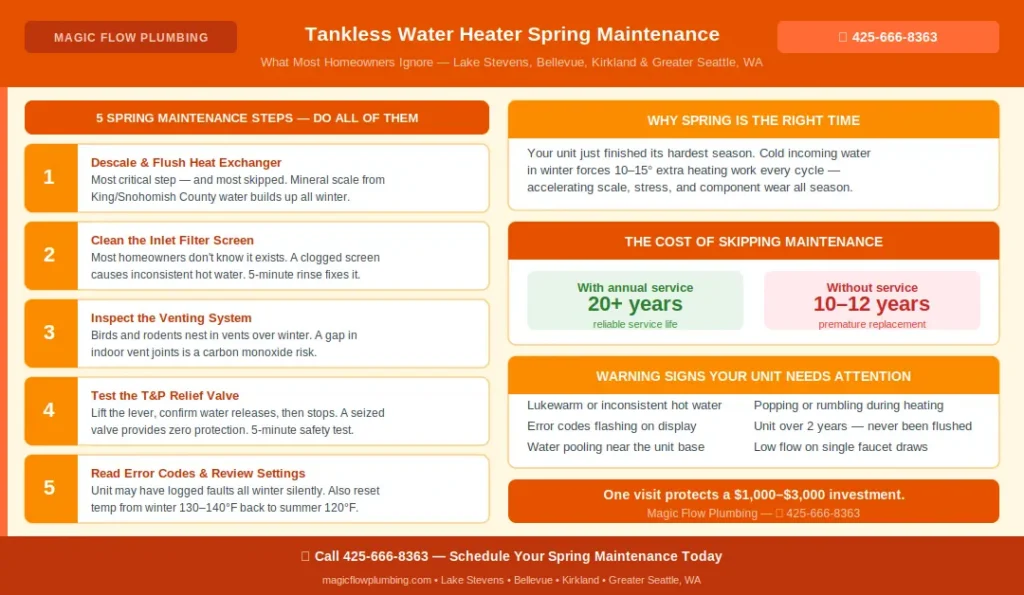
Spring is the most important maintenance window for tankless units across the Greater Seattle, WA area, including Lake Stevens, Bellevue, and Kirkland. Your unit just finished the hardest months of the year. Colder incoming water temperatures through winter force the heater to work harder and longer to reach your set temperature, which accelerates mineral buildup, stresses heating components, and shortens the service life of a unit that should otherwise last 20 years or more.
The homeowners who get two decades of reliable service from their tankless water heater are the ones who maintain it consistently. The ones who don’t are the ones calling us in July with no hot water and a repair bill that dwarfs what annual maintenance would have cost.
At Magic Flow Plumbing, we maintain tankless water heaters for homeowners throughout the Greater Seattle area every spring. Here is exactly what that maintenance involves, what most homeowners skip, and why each item matters.
Step 1: Descaling and Flushing the Heat Exchanger
This is the most critical maintenance task for any tankless water heater, and it’s the one most homeowners have never done.
The water supply throughout King County and Snohomish County carries dissolved minerals, primarily calcium and magnesium. As water moves through your tankless unit’s heat exchanger, those minerals don’t stay dissolved. The heat causes them to precipitate out of the water and deposit on the interior surfaces of the exchanger. Over time, this buildup, called scale or limescale, forms an insulating layer between the heating element and the water passing through it.
The consequence is significant. Your water heater has to work harder and run longer to heat the same volume of water through a scaled exchanger. Energy consumption goes up. The heating element cycles more frequently and runs hotter to compensate, which accelerates wear. In severe cases, scale buildup restricts flow through the heat exchanger entirely, triggering error codes and shutdowns.
A descaling flush uses a food-grade white vinegar solution or a commercial descaler circulated through the heat exchanger with a small pump. The process takes about 45 minutes to an hour and removes accumulated mineral deposits from the previous year. For homes in the Lake Stevens and greater Seattle area with moderately hard water, annual flushing is the standard recommendation. Homes with particularly hard water may benefit from flushing every six months.
If your unit has never been flushed and has been running for more than two years, this is not optional maintenance. It is a necessary repair. Call Magic Flow Plumbing at 425-666-8363 to schedule a descaling service before the buildup causes permanent damage to the heat exchanger.
Step 2: Clean the Inlet Filter Screen
Every tankless water heater has a small screen filter on the cold water inlet line. Its job is to catch sediment and debris before they enter the unit. Most homeowners have never looked at it. Many don’t know it exists.
Over a winter of heavy use, this screen collects fine sediment, mineral particles, and any debris that made it through from the supply line. A clogged inlet screen reduces the flow of water into the unit. Reduced flow can cause the unit to misread demand, heat water inconsistently, or fail to fire at all on low-flow draws, such as a single bathroom faucet running at partial flow.
Cleaning the inlet screen takes about five minutes once the water supply is shut off. The screen is typically located directly on the cold water connection at the base or side of the unit. Remove it, rinse it clean, reinstall it. That’s the entire task.
It’s a simple step that’s easy to overlook and easy to do, and it directly affects the consistency of your hot water delivery, particularly at lower flow rates.
Step 3: Inspect the Venting System
Gas-powered tankless water heaters require proper venting to exhaust combustion gases safely out of your home. The vent system consists of PVC or stainless steel pipes that run from the unit through an exterior wall or up through the roof.
Over a Pacific Northwest winter, venting systems accumulate several specific issues. Nesting material is one of the more common ones. Birds and rodents are drawn to the warmth of exhaust vents in cold months, and by spring it’s not unusual to find partial blockages of nesting debris in outdoor vent terminations. Insects can also build nests in exterior vent caps during warmer stretches of winter weather.
Beyond blockages, inspect the vent pipe joints and connections for any separation or gaps. Vibration over months of use can loosen connections, particularly in long horizontal vent runs. Even a small gap in a vent joint inside the home is a carbon monoxide risk that should be treated as an emergency.
For electric tankless units, the venting concern doesn’t apply, but the importance of inspecting electrical connections, particularly the high-amperage wiring that powers resistance heating elements, is equally important.
If you are not comfortable inspecting your own venting system, this is a reasonable task to include in a professional spring maintenance visit. Proper venting is not a component to guess on.
Step 4: Test the Pressure Relief Valve
The temperature and pressure relief valve, commonly called the T&P valve, is a critical safety component on every water heating system, tankless or traditional. Its function is simple: if pressure or temperature inside the unit exceeds safe limits, the valve opens and releases the excess to prevent a dangerous failure.
The problem with T&P valves is that they are rarely tested and can seize in the closed position over years of disuse. A valve that looks intact but won’t open when it needs to provides no protection at all.
Testing the valve is straightforward. Place a bucket or cloth under the discharge tube, lift the test lever briefly, and confirm that water releases and then stops when the lever is returned. If the valve doesn’t release when lifted, releases but won’t reseal afterward, or shows corrosion around the valve body, it needs replacement.
This is a five-minute test that should be on every homeowner’s annual checklist. We include it in every maintenance visit we perform throughout Bellevue, Kirkland, Lake Stevens, and the broader Greater Seattle, WA area.
Step 5: Check Error Code History and System Settings
Modern tankless water heaters log error codes internally. Even if your unit seems to be running fine, it may have recorded fault events over the winter that indicate developing problems. A unit that briefly lost ignition on a cold morning and restarted itself, or that triggered a high-temperature warning during a heavy-demand period, won’t necessarily tell you with obvious symptoms. The history is stored in the unit’s diagnostics.
A qualified plumber can read your unit’s error code history, interpret what those codes mean, and identify patterns that suggest components under stress before they fail outright. Ignition faults, flow sensor errors, and combustion warnings are all worth investigating even when the unit appears to be operating normally.
Spring is also the right time to review your temperature settings. Many homeowners raise their water heater set point in winter for comfort and forget to adjust it back. Running your water heater at 130 or 140 degrees Fahrenheit year-round when 120 degrees is perfectly comfortable for summer use adds unnecessary energy consumption and accelerates wear on heating components.
What Skipping Maintenance Actually Costs
There’s a straightforward financial case for annual tankless water heater maintenance that’s worth stating plainly.
A quality tankless water heater costs $1,000 to $3,000 installed, depending on the unit and the complexity of the installation. With proper maintenance, a tankless unit should deliver 20 or more years of reliable service. Without maintenance, scaled heat exchangers, stressed components, and undetected faults routinely cut that lifespan to 10 to 12 years. The cost of an annual maintenance visit is a fraction of a premature replacement.
Beyond lifespan, a scaled and struggling tankless unit runs less efficiently every year it goes without service. The energy savings that made your unit attractive in the first place erode progressively as the heat exchanger becomes less effective. A well-maintained unit saves energy; a neglected one quietly erases those savings while you assume everything is fine.
Serving Greater Seattle Homeowners Year-Round
Homeowners in the Greater Seattle, WA area, including Lake Stevens, Bellevue, and Kirkland, deal with specific water quality conditions that make tankless water heater maintenance more important, not less, than national averages might suggest. Our regional water supply, while safe and clean, carries mineral content that accumulates in heating systems at a rate that rewards annual attention.
At Magic Flow Plumbing, we specialize in tankless water heater maintenance, descaling, and repair for homeowners throughout the region. Our spring maintenance service covers all the steps outlined in this guide and gives you a professional assessment of your unit’s condition with honest recommendations. No upselling. No unnecessary work. Just a thorough, professional evaluation that tells you exactly where your water heater stands.
📞 Call 425-666-8363 today to schedule your spring tankless water heater maintenance.
One annual service visit is all it takes to protect a major investment and keep the hot water running reliably for years to come.
Magic Flow Plumbing — proudly serving Lake Stevens, Bellevue, Kirkland, and the Greater Seattle, WA area. Call 425-666-8363.