
Is Your Drain Ready for Spring? Signs You Need Professional Drain Cleaning
By Magic Flow Plumbing | Serving Lake Stevens, Bellevue, Kirkland & the Greater Seattle, WA Area 📞 425-666-8363
Most homeowners don’t think about their drains until something goes wrong. And that’s understandable — a drain that’s working is invisible. It does its job quietly, out of sight, and asks for nothing in return. Until one morning in April when the kitchen sink is holding water for thirty seconds longer than it used to, or the shower has a thin puddle collecting around your feet that wasn’t there last fall.
That’s the moment most people reach for a bottle of chemical drain cleaner, pour it in, and call it solved. Except it’s not solved. It’s masked. And what’s waiting on the other side of that chemical band-aid is months of accumulated buildup that has been quietly narrowing your drain lines all winter — grease, soap scum, hair, mineral deposits, and in some cases the early stages of root intrusion working its way into your underground lines.
In the Greater Seattle, WA area — including Lake Stevens, Bellevue, and Kirkland — winter is hard on drains for reasons that go beyond just heavy use. Colder water temperatures slow the movement of fats and grease through drain lines, causing them to solidify closer to the drain opening. Increased indoor time through the wet months means more cooking, more showers, more sink use, and more material moving through your plumbing than at any other time of year. By the time spring arrives, your drains have been doing the hardest work of the year — and it shows.
Here’s how to read the signs, understand what they mean, and know when a professional drain cleaning is the right call.
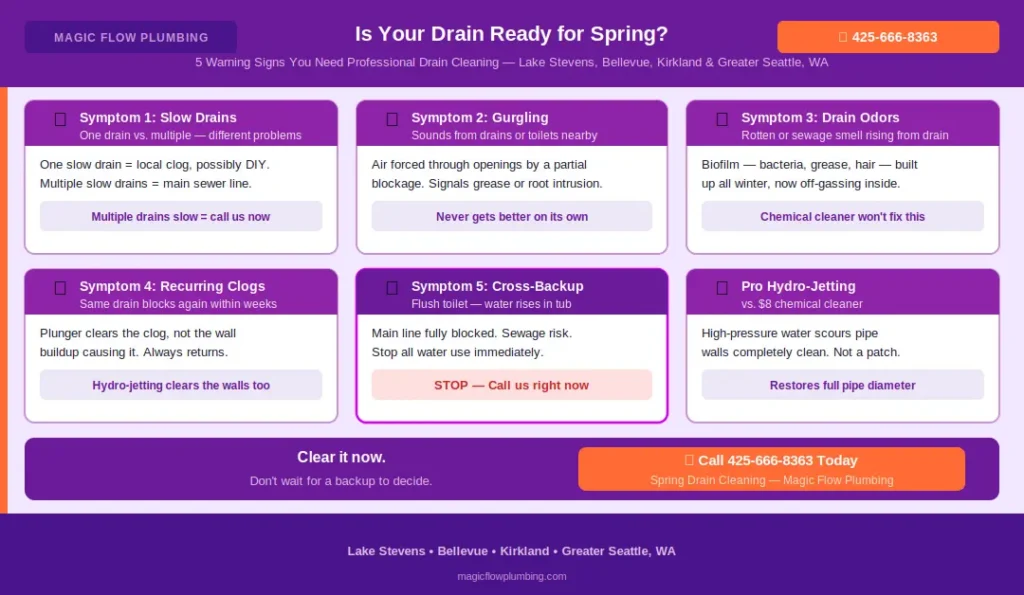
Symptom #1: Slow Drains — One or Several
A slow drain is the most common and most ignored symptom of a drain system under stress. It’s easy to rationalize: the sink drains eventually, the shower clears before you step out, it’s probably just a little buildup.
But here’s what that slowness is actually telling you. Water should move through a properly clear drain line quickly and consistently. When it hesitates, pools, or takes noticeably longer than it once did, the diameter of your drain pipe has been effectively reduced by buildup coating the interior walls. That buildup doesn’t go away on its own. It accumulates. The drain that takes five extra seconds to clear in March takes thirty extra seconds by June and fully backs up in August — at the worst possible time.
The important distinction: A single slow drain points to a localized clog — usually in the P-trap or the first few feet of pipe below the fixture. Multiple slow drains throughout your home simultaneously point to a problem further down the line, closer to — or in — your main sewer line. That’s a fundamentally different problem requiring a different solution.
One slow drain: likely a DIY-manageable clog or a professional cleaning of that line. Multiple slow drains: call Magic Flow Plumbing at 425-666-8363 — this needs professional assessment.
Symptom #2: Gurgling Sounds From Drains or Toilets
Your plumbing shouldn’t make much noise. Water flows, pipes hum faintly — that’s normal. What’s not normal is a gurgling or bubbling sound from a drain or toilet that occurs when a nearby fixture is being used. Flush the toilet and the tub drain gurgles. Run the kitchen sink and the floor drain in the laundry room makes noise.
What you’re hearing is air. Specifically, air being displaced by water trying to move through a partially blocked line. The blockage forces water to find the path of least resistance, and as it does, it pulls air through nearby drain openings — creating that distinctive gurgle.
In Washington homes, this symptom in spring often indicates one of two things: significant grease and debris buildup in a shared drain line that serves multiple fixtures, or early-stage root intrusion in the main sewer line. Both require professional attention. Neither gets better on its own.
The gurgling is your plumbing system communicating clearly. Don’t ignore it. By the time gurgling escalates to the next stage — sewage odors or backups — the problem is considerably more expensive to address.
Symptom #3: Unpleasant Odors From Drains
A properly functioning drain doesn’t smell. The P-trap — the curved section of pipe beneath every sink and shower drain — holds a small amount of standing water that acts as a seal, blocking sewer gases from rising back up through the drain opening into your living space.
When you notice a rotten egg smell, a sewage odor, or a persistent musty smell coming from a drain, one of several things is happening. The P-trap may have dried out from a fixture that hasn’t been used for a while — common in guest bathrooms over winter. More concerning is when the odor persists from regularly used drains, which can indicate biofilm buildup inside the drain line itself — layers of bacteria, decomposing organic matter, grease, and hair that have accumulated over months and are now actively off-gassing into your home.
Across Lake Stevens, Bellevue, and Kirkland, we find this symptom particularly common in kitchen sink drains and bathroom drains after the winter months. The combination of reduced airflow through closed-up homes in winter and increased cooking and bathing frequency creates ideal conditions for biofilm development.
The consequence of ignoring it: Beyond the obvious unpleasantness, biofilm-clogged drains create backflow risk and can harbor bacteria that affect indoor air quality. A professional drain cleaning removes the source of the odor entirely — not just temporarily — by physically clearing the buildup rather than masking it with chemicals.
Symptom #4: Recurring Clogs in the Same Drain
If you’ve cleared a drain once this winter — used a plunger, snaked it yourself, or poured a chemical cleaner down it — and it’s slow or blocked again within a few weeks, that’s not bad luck. That’s a pattern, and it’s telling you something important.
Recurring clogs in the same location mean the root cause was never addressed. A plunger moves a clog; it doesn’t remove the buildup on the pipe walls that caused the clog to form. A chemical drain cleaner dissolves a portion of an organic clog; it doesn’t clear the grease coating or mineral scale that lined the pipe and narrowed the flow path. The clog reforms because the conditions that created it are still present.
This is the most common scenario we encounter when homeowners in the Greater Seattle, WA area call us in late spring with “a drain problem that keeps coming back.” By that point, they’ve spent $30–$60 on chemical cleaners and a few hours on DIY attempts, and they’re right back where they started — except the buildup has been partially disrupted and redistribued further down the line.
A professional drain cleaning with hydro-jetting equipment removes the buildup from the interior walls of the pipe, not just the immediate blockage. The result is a pipe that’s restored to close to its original flow capacity — not just temporarily cleared.
Symptom #5: Water Backing Up Into Other Fixtures
This one is unmistakable and requires no diagnostic uncertainty. You run the dishwasher and water backs up into the kitchen sink. You flush the toilet and water rises in the tub. You drain the washing machine and the utility sink overflows.
Cross-fixture backups mean that wastewater has nowhere to go in a shared drain line and is finding the nearest available opening to reverse into. This is no longer a slow drain situation — this is an active blockage in a main drain line or, in severe cases, the primary sewer line exiting your home.
In Washington, spring is exactly when this escalation happens. Root intrusion that grew slowly through winter, combined with peak water usage as homeowners return to outdoor tasks and full household routines, creates the pressure event that turns a manageable partial blockage into a full backup.
Do not continue using your plumbing if you’re experiencing cross-fixture backups. Using additional water will worsen the backup and risk sewage overflow into your home. Call Magic Flow Plumbing immediately at 425-666-8363. We serve Lake Stevens, Bellevue, Kirkland, and the surrounding Greater Seattle, WA area and can respond quickly to drain emergencies.
Why Chemical Drain Cleaners Are Not the Answer
We understand the appeal. A bottle of chemical drain cleaner is $8, it’s available at every grocery store, and it promises to dissolve clogs fast. The problem isn’t that they don’t work at all — it’s that they work just enough to convince you the problem is solved when it isn’t.
Chemical drain cleaners work through a corrosive reaction that generates heat and breaks down organic material. What they can’t do is remove grease that has solidified on pipe walls, clear mineral scale, dislodge physical debris like hair masses and soap scum accumulation, or address root intrusion. They also generate heat that, in older PVC pipe, can cause joint softening and warping over repeated use. And in homes with older iron or clay drain pipes — still present in many established neighborhoods in Kirkland and Bellevue — the corrosive chemistry accelerates pipe degradation.
For a single, minor, fully organic clog close to a drain opening, a chemical cleaner may resolve the immediate issue. For anything else — slow drains, recurring clogs, gurgling, odors, or backups — they’re a temporary mask over a problem that is continuing to develop.
What Professional Drain Cleaning Actually Does
A professional drain cleaning from Magic Flow Plumbing is not the same as running a snake down your drain. For most drain cleaning jobs, we use hydro-jetting — a high-pressure water system that scours the interior walls of your pipe, removing grease buildup, mineral deposits, biofilm, and debris completely.
The difference is the difference between rinsing a greasy pan under the faucet versus scrubbing it clean. A drain snake punches a hole through a clog. Hydro-jetting removes what’s clinging to the pipe walls and restores the full diameter of the line.
For suspected root intrusion or more complex main line issues, we combine drain cleaning with a camera inspection so you can see exactly what’s inside your pipes and make an informed decision about the right repair.
Spring Is the Best Time — Not After a Backup
The best time to schedule a professional drain cleaning is before something fails. A spring drain cleaning clears everything winter deposited in your lines, restores flow before peak summer use, and gives you the peace of mind of knowing your drain system is in clean, working order heading into the busiest months of the year.
The worst time is after a backup — because at that point you’re dealing with an emergency, potential property damage, and a much larger repair bill than a routine cleaning would have cost.
At Magic Flow Plumbing, we make it easy for homeowners across Lake Stevens, Bellevue, Kirkland, and the Greater Seattle, WA area to get ahead of drain problems before they escalate. A routine professional drain cleaning is one of the most cost-effective preventive maintenance services you can schedule for your home.
📞 Call 425-666-8363 today to schedule your spring drain cleaning.
Clear it out now. Don’t wait for the backup to make the decision for you.