Why Your Water Bill Goes Up in Spring (And How to Fix It Fast)
By Magic Flow Plumbing | Serving Lake Stevens, Bellevue, Kirkland & the Greater Seattle, WA Area 📞 425-666-8363
You open your water bill in May and do a double-take. It’s noticeably higher than it was in January — and you haven’t done anything differently. No longer showers. No new appliances. No houseguests. So where is all that water going?
You’re not imagining it, and you’re not alone. Every spring, homeowners across Lake Stevens, Bellevue, Kirkland, and the Greater Seattle, WA area call us at Magic Flow Plumbing asking the same question. The answer is almost always one of a handful of predictable culprits — and the good news is that most of them are fixable quickly, and some are fixable for free.
The bad news? If you ignore a rising water bill, the problem doesn’t plateau. It compounds. A hidden leak that costs you an extra $30 a month in April can destroy a wall, rot a subfloor, or spike your bill by hundreds of dollars by August. This is a money problem that only gets more expensive the longer you wait.
Here’s what’s most likely driving up your water bill this spring — and exactly what to do about it.
The #1 Culprit: A Toilet That’s Secretly Running
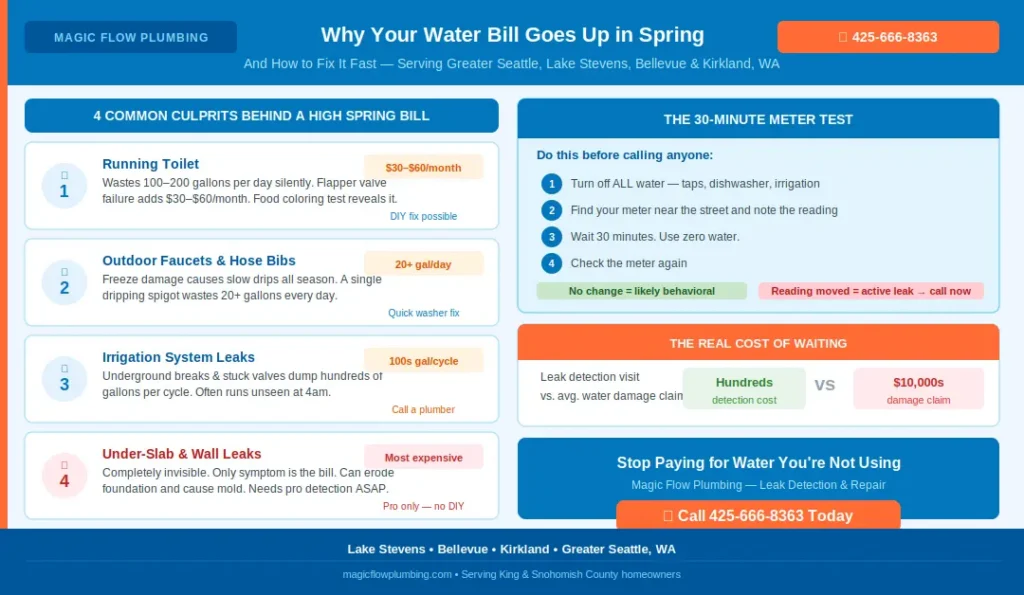
It sounds small. It doesn’t sound like much at all, actually — maybe a faint hiss you’ve tuned out. But a running toilet is the single most common cause of an unexplained spike in residential water bills, and it can waste anywhere from 100 to 200 gallons of water per day.
Do the math: 150 gallons a day over 30 days is 4,500 gallons. At Greater Seattle area water rates, that can add $30–$60 to your monthly bill from a single toilet — and most homeowners have no idea it’s happening.
The fix: Drop a few drops of food coloring into the toilet tank. Don’t flush. Wait 10 minutes. If color seeps into the bowl, your flapper valve is failing and water is silently draining through. A new flapper costs a few dollars at any hardware store and takes 10 minutes to replace — it’s one of the few plumbing fixes most homeowners can handle themselves.
If the problem persists after replacing the flapper, or if you have multiple toilets showing this issue, it’s time to call a plumber. There may be a bigger problem with the fill valve or the tank seal.
Outdoor Faucets and Hose Bibs: The Ones You Forgot About All Winter
Here’s a scenario we see constantly in Lake Stevens and Kirkland every spring: a homeowner reconnects their garden hose to an outdoor spigot for the first time since October — and that spigot has a slow drip they never noticed before. Maybe it froze slightly over winter. Maybe the washer finally wore out. Either way, it’s now dripping 24 hours a day, seven days a week, straight into your lawn.
A dripping outdoor faucet can waste 20 gallons or more per day. Multiply that by a few months of outdoor season and you’re looking at potentially thousands of gallons gone — and none of it watered your garden usefully.
The fix: Walk every outdoor faucet on your property and turn each one on and off fully. Watch the spigot face and the connection point for any dripping after you close it. A dripping spigot usually just needs a new washer or packing — a quick, inexpensive repair. However, if the faucet is dripping from inside the wall, or if there’s no obvious external drip but your bill is still climbing, that freeze damage may be internal and invisible.
Irrigation Systems: The Biggest Wildcard
Across Bellevue, Kirkland, and the surrounding communities, many homes have in-ground irrigation systems that have been dormant all winter. When homeowners fire them up in spring, they often discover — via their water bill — that something went wrong during the off-season.
Irrigation line breaks, stuck-open zone valves, and misaligned heads can collectively dump hundreds of gallons into your yard every time the system runs. Because it’s happening underground or during early morning hours when no one is watching, these leaks often go undetected for weeks.
The fix: Before running your irrigation system for the first time this spring, do a manual walkthrough of every zone. Activate each zone individually from the controller and physically walk the area while it runs. Look for unusual wet patches between runs, pooling water, or heads that won’t retract. If a zone seems to be running longer than normal to achieve the same result, you likely have a pressure loss somewhere in the line.
A professional leak detection service can pinpoint irrigation line breaks without tearing up your yard. If your water bill jumped right around the time you activated irrigation for the season, don’t wait — this one won’t fix itself.
Under-Slab and Behind-Wall Leaks: The Invisible Drain
Some of the most expensive water waste comes from leaks you absolutely cannot see. Under-slab leaks — pipes running beneath your home’s foundation — and behind-wall leaks can run continuously for months without a visible sign of water damage. The only symptom you notice is the bill.
Warning signs beyond a high water bill include warm spots on your floor (a sign of a hot water line leak beneath the slab), the sound of running water when all fixtures are off, or unexplained damp or soft spots on lower-level flooring.
The fix: There’s no DIY solution here. Under-slab and behind-wall leaks require professional leak detection equipment — acoustic sensors and pressure testing tools that can locate a leak without destructive exploratory work. The sooner you catch a slab leak, the less damage you’re dealing with. Left alone, they erode your foundation, breed mold, and turn a contained repair into a major renovation.
If you’re in the Lake Stevens, Bellevue, or Kirkland area and suspect a hidden leak, call us at 425-666-8363. We offer professional leak detection throughout the Greater Seattle, WA region.
The Meter Test: Rule Everything Out in 30 Minutes
Before you call anyone, try this. It takes 30 minutes and requires nothing but the ability to find your water meter.
- Make sure no water is being used anywhere in your home — no toilets running, no dishwasher, no irrigation timer active.
- Locate your water meter (usually near the street at the edge of your property).
- Note the exact reading on the dial.
- Wait 30 minutes. Don’t use any water.
- Check the meter again.
If the reading has changed, water is moving through your system with everything turned off. You have an active leak somewhere. That’s not a “keep an eye on it” situation — that’s a call-a-plumber situation.
If the reading hasn’t changed but your bill is still higher than expected, the culprit is more likely behavioral (irrigation use, more frequent watering, seasonal guests) or intermittent rather than continuous.
What Leak Detection Actually Costs — vs. What It Saves
We understand that calling a plumber feels like an expense. But here’s the realistic math. A professional leak detection visit from Magic Flow Plumbing is a fraction of what a month of undetected leaking costs in water bills alone — let alone what a slab leak or burst irrigation line costs in property damage.
The average insurance claim for water damage in a residential home runs into the tens of thousands of dollars. Finding and fixing a leak early doesn’t cost you money. It stops money from quietly draining out of your home every single day.
Don’t Overpay for Water You’re Not Using
A rising spring water bill is your home trying to tell you something. The message is almost always the same: there’s water going somewhere it shouldn’t be, and the longer it keeps going there, the more it’s going to cost you.
At Magic Flow Plumbing, we specialize in leak detection and repair for homeowners across Lake Stevens, Bellevue, Kirkland, and the Greater Seattle, WA area. We’ll find where your water — and your money — is going, and we’ll fix it fast.
📞 Call us today at 425-666-8363 to schedule a leak detection appointment.
Stop paying for water you’re not using.